
Biotin and derivatives


Medchemexpress LLC Sulfo-NHS-biotin sodium | 194041-65-1 | MFCD00078535 | ≥90.0% | C14H18N3NaO8S2 | 10MG

Sulfo-NHS-Biotin sodium is a water-soluble, amine-reactive biotinylation reagent that covalently labels primary amines on proteins and other biomolecules. The sulfonated N-hydroxysuccinimide ester increases aqueous solubility, allowing efficient labeling in physiological buffers and streamlined downstream analysis for detection and affinity workflows.
- Water-soluble amine-reactive reagent for labeling primary amines.
- Enables efficient labeling in aqueous buffers without organic solvents.
- Supports detection, pull-downs, and affinity purification workflows.
- High solubility in water and DMSO for flexible formulation.
- Stable when stored sealed and protected from moisture; follow datasheet handling.
- Available as a solid or as a pre-made DMSO solution for convenience.


Medchemexpress LLC Azido-PEG24-NHS ester | 2375600-46-5 | 95.0% | C55H104N4O28 | 10MG
Azido-PEG24-NHS ester is a polyethylene glycol (PEG) linker bearing an azide and an N-hydroxysuccinimide (NHS) ester functional group. It is designed for bioconjugation and linker synthesis, enabling both click chemistry and amine-directed coupling while improving solubility and flexibility in conjugates.
- Azide functional group enables click chemistry with alkynes.
- NHS ester reacts with primary amines to form stable amide bonds.
- PEG24 spacer provides enhanced water solubility and flexible linker length.
- Suitable for PROTAC synthesis, drug conjugates, and general bioconjugation.
- High purity (~95.0%) suitable for research use.
- Available in small milligram quantities for exploratory synthesis.

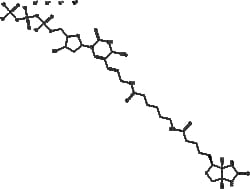
Apexbio Technology LLC Biotin-11-dUTP(Synonyms: Biotin-11-deoxyuridine triphosphate, Biotin-11-dUTP lithium salt), 10ul (5 mM), CAS: 1221498-88-9.
Biotin-11-dUTP (CAS 1221498-88-9) is a biotin-conjugated analogue of deoxythymidine triphosphate (dTTP) that can be incorporated enzymatically into DNA or cDNA sequences during polymerase reactions After integration labeled nucleic acid fragments can be detected using streptavidin coupled to horseradish peroxidase (HRP) alkaline phosphatase (AP) fluorescent molecules or bead-based capture systems This approach is frequently utilized in polymerase chain reaction (PCR) nick translation reverse transcription assays and apoptosis studies facilitating DNA probe labeling and molecular analysis workflows

Apexbio Technology LLC Sulfo-NHS-LC-Biotin, 100mg. Cas: 127062-22-0 MFCD: MFCD00078534. Amine-reactive biotinylation reagent, long chain
Intermediate length, water-soluble biotinyltation reagent used to attach biotin to primary amines 127062-22-0. MFCD00078534
Sigma Aldrich Fine Chemicals Biosciences Biotin meets USP testing specifications | 58-85-5 | MFCD00005541 | 5G
Biotin meets USP testing specifications | Purity: 97.5-102.0% | Mol Wt: 244.31 | 58-85-5 | MFCD00005541 | 5G


Sigma Aldrich Fine Chemicals Biosciences Biotin European Pharmacopoeia (EP) Reference Standard | 58-85-5 | MFCD00005541 |
Biotin European Pharmacopoeia (EP) Reference Standard | Mol Wt: 244.31 | 58-85-5 | MFCD00005541 |
Sigma Aldrich Fine Chemicals Biosciences Biotin powder, BioReagent, suitable for cell culture, suitable for insect cell culture, suitable for plant cell culture, >=99% | 58-85-5 | MFCD00005541 | 5G
Biotin powder, BioReagent, suitable for cell culture, suitable for insect cell culture, suitable for plant cell culture, >=99% | Purity: >=99% | Mol Wt: 244.31 | 58-85-5 | MFCD00005541 | 5G
Apexbio Technology LLC DOTA-NHS-ESTER-100MG
DOTA-NHS-ester (CAS No 170908-81-3) is widely utilized in biomedical research primarily for its role as a bifunctional chelating agent used in radiolabeling and conjugation processes Originating from the conjugation of DOTA (a macrocyclic chelator) with N-hydroxysuccinimide (NHS) this compound facilitates the attachment of radioactive metals to biomolecules enhancing imaging and therapeutic applications It operates by forming stable complexes with metal ions targeting specific pathways for precise diagnostic or therapeutic delivery In vitro activities typically exhibit a nanomolar to low micromolar range making it suitable for various applications such as drug screening cell labeling and receptor targeting in oncology research Its use extends to both cell models and animal studies allowing for robust experimental analysis Experimental concentrations typically depend on the specific research design ensuring versatility across different scientific investigations

Medchemexpress LLC DBCO-NHS ester 2 1g | 1384870-47-6 | 1 G
DBCO-NHS ester 2 is a dibenzoazacyclooctyne (DBCO)-containing N-hydroxysuccinimide (NHS) ester reagent for strain-promoted alkyne-azide cycloaddition (SPAAC). It is used to install a DBCO handle on amine-containing molecules for copper-free click conjugation to azide-functionalized partners and as a cleavable linker in bioconjugation workflows.
- Amine-reactive NHS ester for efficient coupling to primary amines.
- DBCO group enables strain-promoted copper-free click chemistry with azides.
- Suitable for bioconjugation and linker formation in antibody-drug conjugates.
- High reported purity for reproducible conjugation performance.
- Supplied as a 1 g quantity for small-scale synthesis and labeling.

Medchemexpress LLC DOTA-NHS-ester | 170908-81-3 | MFCD23381190 | >97.0% | 501.49 | C20H31N5O10 | 500 MG
DOTA-NHS-ester is a bifunctional chelator containing a DOTA macrocycle and an N-hydroxysuccinimide (NHS) ester. It enables covalent conjugation to amine-containing biomolecules and subsequent radiometal chelation for imaging or radiotherapy research applications.
- Bifunctional chelator with NHS-ester for amine conjugation.
- High purity (≥97.0%) solid suitable for research.
- Molecular weight 501.49 and formula C20H31N5O10.
- Soluble in DMSO (50 mg/mL) and compatible with common in vivo formulations.
- Store powder at -20°C; solutions at -80°C (6 months) or -20°C (1 month).
- Available in a 500 mg pack size.

Medchemexpress LLC Azido-PEG3-SS-NHS | 95.0% | 436.50 | C15H24N4O7S2 | 5 MG
Azido-PEG3-SS-NHS is a cleavable three-unit polyethylene glycol (PEG) linker intended for bioconjugation and antibody-drug conjugate synthesis. It contains an azide for click chemistry, a disulfide bond for reductive cleavage, and an N-hydroxysuccinimide (NHS) ester for amine coupling.
- Contains azide for copper-catalyzed and strain-promoted click reactions.
- Contains NHS ester for efficient conjugation to primary amines.
- Includes a cleavable disulfide spacer for intracellular release.
- Suitable for linker design in ADC, PROTAC, and other bioconjugation workflows.
- Supplied as a liquid, colorless to light yellow, with reported purity of 95.0%.

Medchemexpress LLC DBCO-NHS ester | 1353016-71-3 | 99.5% | 402.40 | C23H18N2O5 | 10 MG
DBCO-NHS ester is a dibenzocyclooctyne N-hydroxysuccinimidyl ester used as a click-chemistry linker to enable strain-promoted alkyne-azide cycloaddition (SPAAC) for bioconjugation and antibody-drug conjugate synthesis. Supplied as a powder with recommended storage and handling guidance; suitable for laboratory research applications.
- Click-chemistry reagent for strain-promoted alkyne-azide cycloaddition (SPAAC).
- High purity (≈99.5% by LCMS).
- Molecular weight 402.40, chemical formula C23H18N2O5.
- Available in small-mg packages for research use.
- Store as powder at -20°C; follow SDS for solution storage and handling.